
The Coolest Knick
Walt Frazier was an exemplar of the philosophy of cool

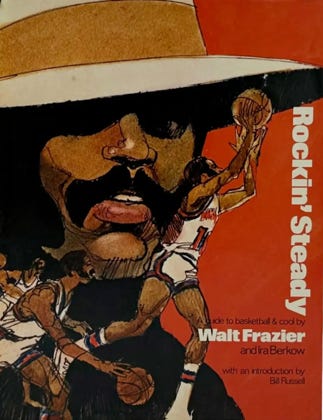
Timing is everything. My hometown Knicks are charging towards their first NBA Championship in fifty years, and so I’m kicking off this Substack with a profile of Walt Frazier, aka Clyde. The playmaker and ball thief of the great 1968-1974 Knick teams, Frazier was one of the 100 icons I chose for the American Cool exhibit. As I’ve explored in my books, cool is a complex concept: in music, film, and sports, it is both an expressive style and a form of stylish stoicism. Frazier even wrote a book about it: Rockin’ Steady: A Guide to Basketball & Cool. “Some cool is natural,” he wrote, “but a lot of cool is learned.”
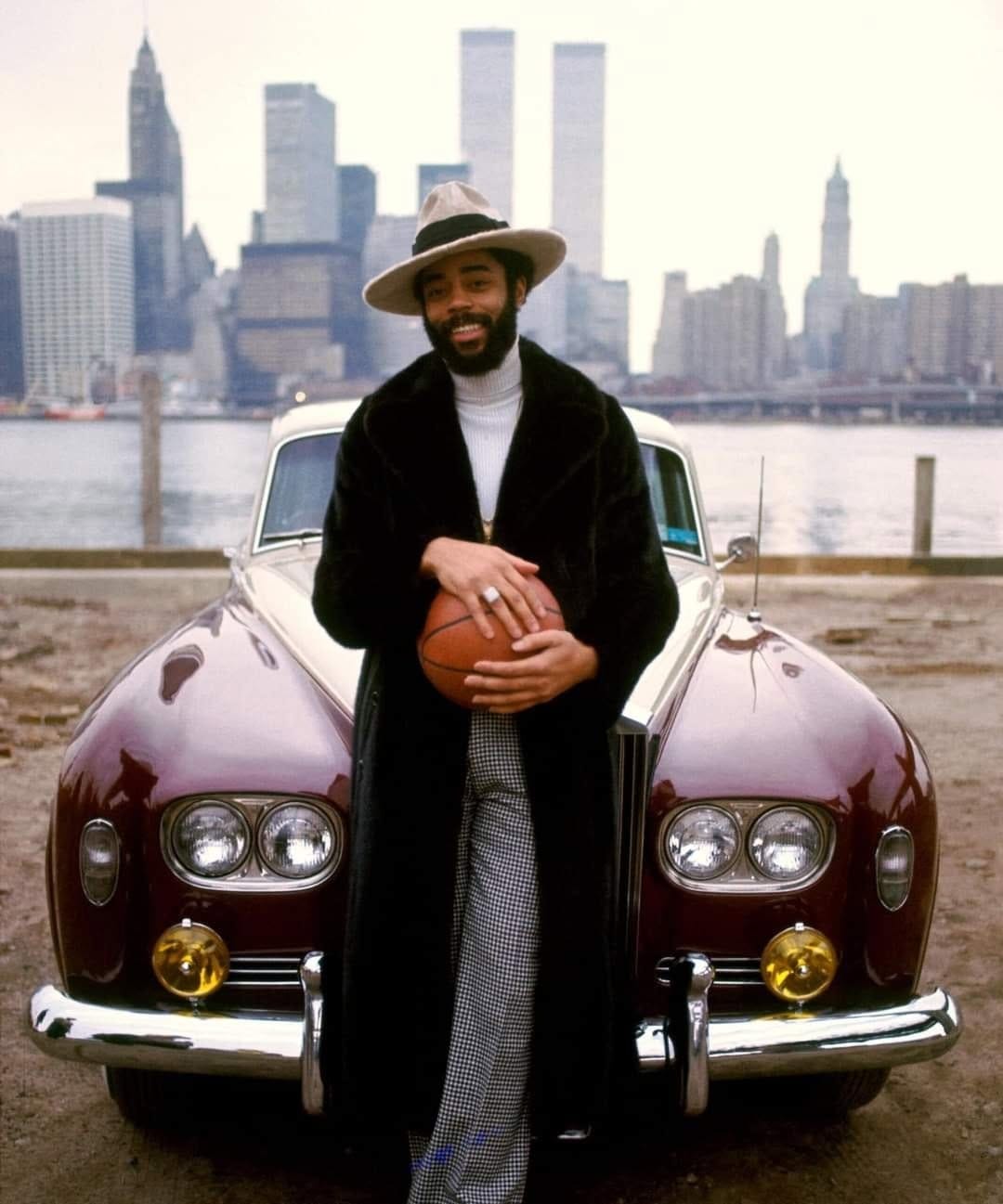
His nickname was Clyde, after the movie Bonnie & Clyde (1967), for how he robbed the ball from opponents and for his fur-coat-and-Rolls sartorial style. Some of his steals seemed like a magic trick: a man would be dribbling confidently when suddenly the ball just disappeared. Frazier knew how to get inside a man’s rhythm, like a ninja.
In the iconic 1970 Knick-Laker finals, Frazier stole the ball from two all-time NBA greats, Elgin Baylor and Jerry West. Baylor was backing down his defender when Frazier slipped in from his blind side, causing Baylor to stumble then give futile chase. Jerry West was bringing the ball up in full stride when suddenly the ball was going the other way. West couldn’t believe his hands and eyes, blew his cool, then charged after Frazier, enraged.
Frazier’s court style was more subtle than explosive, and he controlled the team’s temperament. Even if an opponent had him psyched out, “I always look cool,” he wrote, “so they never know what I’m thinking.” Frazier understood that cool is, in part, an emotional mask. “Cool is my style. I almost never show any emotion on the court.”
One trunkline of cool is a Black aesthetic — derived from both the West African cultural ideal of spiritual calm and the American environment. “Cool is a matter of self-preservation, of survival,” Frazier wrote, “go[ing] back to the slave days, when oftentimes all a Black man had to defend himself with was his poise.” So when he heard the N-word, Frazier let it roll off his back.
I have defined cool as an aesthetics of detachment. In the midst of performance, it is a paradox of relaxed intensity. As Toni Morrison once reflected, “Black art must look effortless. It must look cool and easy. If it makes you sweat, you haven’t done the work. You shouldn’t be able to see the seams and stitches.”
Frazier was always a threat one-on-one but he never hogged the ball, always contributing what the team needed. In Game 7 of that iconic 1970 championship final, with high-scoring Knicks center Willis Reed out with an injured knee, Frazier stepped up and gave an all-around basketball clinic in a legendary performance: 36 points, 19 assists, 7 rebounds, and 5 steals on 70% shooting from the field (12-for-17) and 100% shooting from the foul line (12-for-12).
Cool requires a sense of composure, even within improvisation. In basketball, when a team clears out to allow their franchise player to go one-on-one — as the Knicks often do for Jalen Brunson in the 4th quarter — there is no plan. Fake right, go left, spin, change direction off a pick, all of this is baked-in from intelligence, practice, intuition, muscle memory. It is one aspect of the spontaneous, real-time chess game of offense-defense under a 24-second clock. As Frazier wrote about taking a player off the dribble, “I don’t know what’s going to happen.”
Neither do we — that’s why we watch.
“I think I’m cool,” Frazier wrote about his personal life, “most of the time.” That’s all anyone can hope for. But on the court, Clyde seemed cool all of the time.
Go Knicks!
Hi Joei,
Clyde was my basketball hero growing up! Thanks for the memories.